
AI is Browsing Your Website: Understanding PageSpeed’s New "Agentic Browsing" Metric
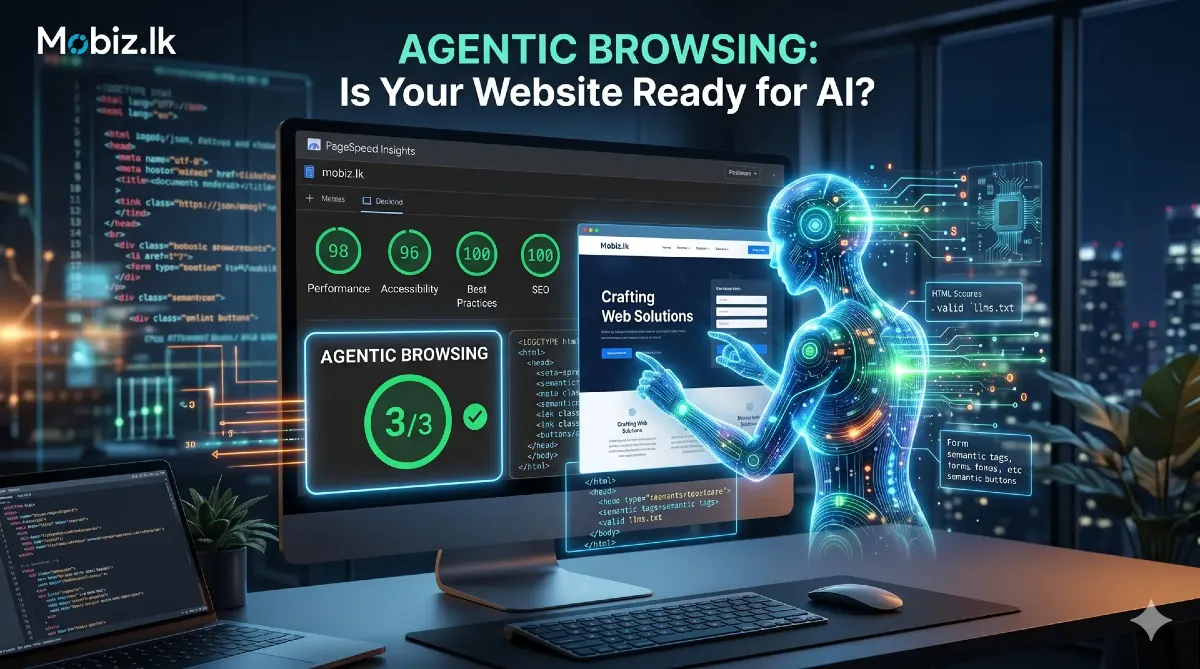
Google recently updated PageSpeed Insights with a new "Agentic Browsing" metric. But instead of measuring human user experience, it evaluates how well AI bots and automated assistants can navigate, understand, and interact with your site. Here is what this new score means and how to future-proof your web presence.

Amila Rajapaksha is the CEO and Managing Director of Mobiz International (Pvt) Ltd, a web design and development company based in Gampaha, Sri Lanka. Since 2010 he has helped businesses across Sri Lanka and overseas launch fast, search-friendly websites and online stores — working hands-on with WordPress, Magento and custom Laravel builds, and the SEO that makes them rank.
If you’ve run a website audit recently, you might have noticed a quiet but massive update to Google’s PageSpeed Insights. Sitting right beneath the familiar 0–100 scores for Performance, Accessibility, Best Practices, and SEO is a brand new category: Agentic Browsing, scored as a simple fraction like 3/3.
At Mobiz, we spend a lot of time optimizing web applications for speed and search visibility, so we started digging into this right away. Here is what you need to know about Agentic Browsing, why it’s there, and what it means for the future of web design.
It’s No Longer Just About Human Visitors
For years, web development has focused entirely on the human experience—making sure pages load quickly on mobile, UI elements are easy to tap, and layouts don't unexpectedly jump around.
But the web is changing. People are increasingly relying on AI assistants, automated shopping bots, and LLM-driven research tools to browse the internet on their behalf. Agentic Browsing measures exactly that: how well your website is built for an AI agent to navigate, understand, and complete tasks without a human driving the mouse.
If an AI assistant can’t figure out how to read your service pages or click your "Add to Cart" button, you are effectively locking out a rapidly growing segment of digital traffic.
What Exactly is Lighthouse Testing?
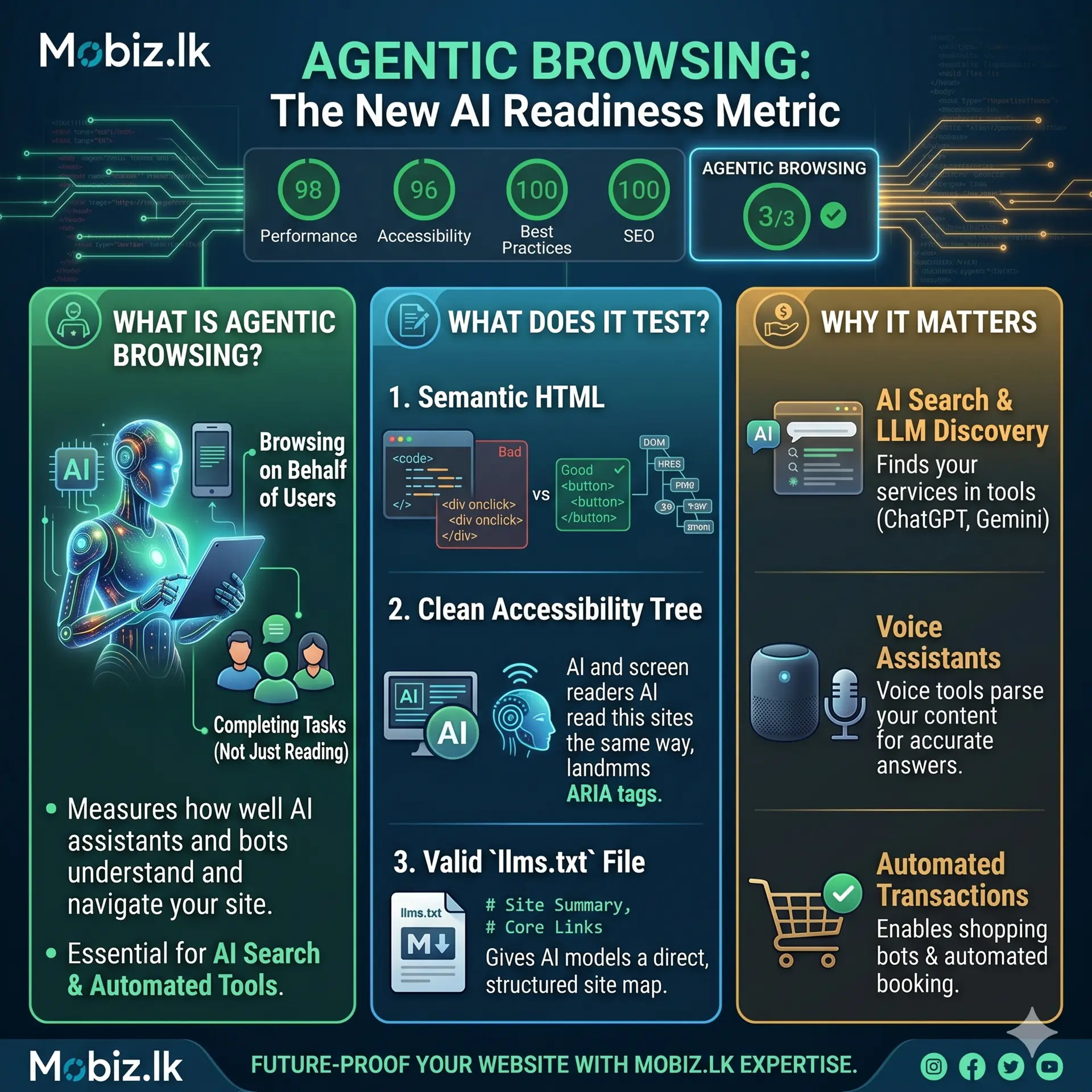
Instead of scoring your site on a curve, this new metric runs a strict pass/fail test on a few foundational technical elements. AI doesn't care about modern, flat design aesthetics or hover animations; it cares about the machine-readable structure underneath.
Here is what the engine is looking for to give you a perfect score:
- A Clean Accessibility Tree: Screen readers and AI agents read websites the same way. If you build a call-to-action button out of a styled <div> instead of a proper HTML <button> tag, an AI agent has to guess what it does. Clean, semantic HTML is no longer optional.
- Rock-Solid Layouts: You likely know Cumulative Layout Shift (CLS) as an annoyance when reading an article. For an AI agent that uses screen coordinates to click a button, a shifting layout breaks the entire automated task. Stable DOM rendering is critical.
- The llms.txt Standard: This is a relatively new concept in the SEO and AI space. Similar to a robots.txt file, an llms.txt file sits in your site’s root directory. It provides AI models with a simplified, clean Markdown summary of your site's architecture, giving them a direct map so they don't have to blindly scrape and guess.
- Actionable Data (WebMCP): For e-commerce and booking platforms, Lighthouse checks for WebMCP integration. This protocol helps AI agents confidently fill out forms, book appointments, or filter searches using explicitly structured data pathways rather than raw HTML parsing.
Why We’re Paying Attention
We've always believed that robust web design requires strong foundations clean server administration, logical architecture, and optimized code. The introduction of Agentic Browsing proves that those behind-the-scenes details matter more than ever.
If your site looks beautiful but relies on messy, unstructured code, an AI assistant will simply skip it and pull answers or make purchases from a competitor's site that it can actually read.
The good news? Fixing these issues usually aligns perfectly with standard SEO and accessibility best practices. By making your site easier for an AI to navigate, you are almost always making it faster and more accessible for your human users, too.
Related Articles
Website Visitor Tracking Tools to Boost UX
I still remember the first time I realized the importance of understanding my website visitors' behavior. I had spent months perfecting my website's design and content, but despite my best efforts, conversions were stagnant. It wasn't until I started...

The Best SEO Management Tools You Need in 2026
Discover top SEO tools for 2026. Compare features, pricing & capabilities of leading platforms for keyword research, audits & tracking.
7 Best Website Visitor Tracking Tools to Boost UX, SEO & Conversions
Discover the top 7 visitor tracking tools to boost UX, SEO & conversions. Heatmaps, session recordings & analytics for smarter website optimization.

SEO Management Tools You Need in 2026
You're likely no stranger to the frustration of trying to optimize your website's search engine ranking, only to find that your efforts are yielding little to no results. Despite the countless hours spent researching keywords, crafting meta descripti...