
How can websites use AI to increase customer engagement ?

Picture a customer in Kandy browsing your online store at 11pm. She has a question about delivery to her area, but your team went home hours ago. Without an answer, she closes the tab and buys from a...

Amila Rajapaksha is the CEO and Managing Director of Mobiz International (Pvt) Ltd, a web design and development company based in Gampaha, Sri Lanka. Since 2010 he has helped businesses across Sri Lanka and overseas launch fast, search-friendly websites and online stores — working hands-on with WordPress, Magento and custom Laravel builds, and the SEO that makes them rank.
Picture a customer in Kandy browsing your online store at 11pm. She has a question about delivery to her area, but your team went home hours ago. Without an answer, she closes the tab and buys from a competitor whose chatbot replied in seconds. That's the gap AI for customer engagement is designed to close.
You don't need a Silicon Valley budget to use it. Sri Lankan businesses of all sizes, from boutique fashion sellers to tour operators and service providers, can now add practical AI features to their websites. This guide covers what works, what it costs in effort, what the law expects of you, and how to start without wasting money.
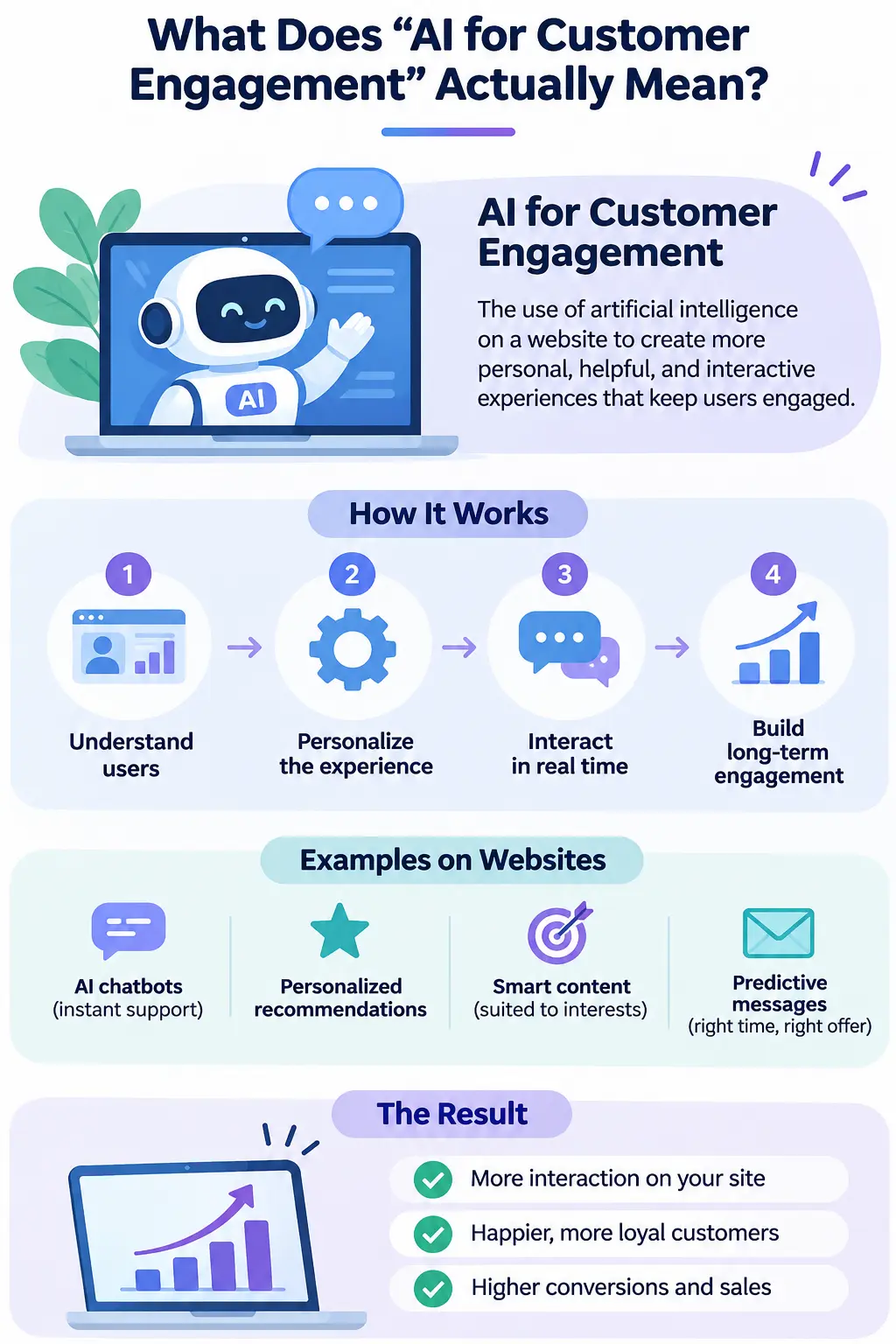
What Does "AI for Customer Engagement" Actually Mean?
It means using machine learning and language models to make every interaction on your website more relevant, faster and more helpful. Engagement isn't just clicks. It includes how long visitors stay, whether they ask questions, whether they return, and whether they buy, subscribe or recommend you.
In practice, AI supports engagement in five main ways:
- Conversation: chatbots and virtual assistants that answer questions instantly.
- Personalisation: showing each visitor the products, content or offers most likely to interest them.
- Prediction: spotting which visitors are about to leave or which customers are likely to buy again.
- Automation: sending the right message at the right time through email, SMS or WhatsApp.
- Insight: analysing feedback, reviews and search behaviour at a scale no human team could manage.
Why It Matters for Sri Lankan Websites Right Now
Sri Lankan customers are increasingly digital and mobile-first. DataReportal's annual Sri Lanka report tracks internet, mobile and social media use in the country, and it consistently shows that most people go online from their phones and spend significant time on social platforms [1]. That means your website competes for attention with Facebook, Instagram, TikTok and WhatsApp, where responses are expected within minutes.
Expectations are also rising globally, and local customers who shop on international sites carry those expectations over. McKinsey's research on personalisation found that most consumers expect companies to personalise their interactions, and a majority get frustrated when that doesn't happen [2]. If your site treats every visitor identically, you're leaving engagement on the table.
1. Use AI Chatbots to Answer Questions 24/7
A chatbot is usually the easiest and most visible AI upgrade. Modern chatbots built on large language models can understand natural questions, not just keywords, and respond conversationally.
Where chatbots work best
- Product and service questions: sizes, specifications, availability, pricing ranges.
- Order and delivery queries: "Where's my parcel?" and "Do you deliver to Jaffna?" account for a big share of e-commerce enquiries.
- Booking and appointments: clinics, salons, hotels and tuition centres can let visitors book without a phone call.
- Lead qualification: asking a few questions, then passing a warm lead to your sales team.
Think multilingual from day one
Your visitors may write in English, Sinhala, Tamil or a mix, including Sinhala typed in English letters ("Singlish"). Machine translation tools now support both Sinhala and Tamil [3], and many modern AI models handle them reasonably well. Quality still varies, especially for casual or mixed-language text, so test your chatbot with real examples from your customers before launch. Always give visitors an easy way to reach a human.
Connect it to WhatsApp
WhatsApp is the default messaging app for many Sri Lankans. The WhatsApp Business Platform lets companies connect automated assistants, send order updates and manage customer conversations at scale [4]. Linking your website chat and WhatsApp means customers can start on your site and continue on the app they already use every day.
2. Personalise the Website Experience
Personalisation turns a static website into one that feels built for each visitor. AI makes this possible without hand-writing hundreds of rules.
Product and content recommendations
Recommendation engines analyse what visitors view, search for and buy, then suggest relevant items. A Colombo fashion retailer might show monsoon-ready footwear to someone browsing raincoats. A Galle guesthouse might highlight beach-side rooms to a returning visitor who looked at them before.
Smart on-site search
Standard website search fails when someone types "cheap laptop for uni" or misspells a product name. AI-powered search understands intent, forgives typos and ranks results by relevance. Better search directly improves engagement because people who find things quickly keep browsing.
Dynamic homepage and offers
You can adjust banners, offers and featured categories by visitor type, such as new versus returning, or by season. Sri Lanka's retail calendar offers plenty of triggers: Avurudu, Vesak, Christmas, the school term and the Poson and Esala festivals. AI can help you schedule and test these messages automatically.
3. Predict Behaviour and Act Before Customers Leave
Predictive models learn from past behaviour to estimate what a visitor will do next.
- Cart abandonment recovery: if a visitor leaves with items in their basket, an automated reminder by email or WhatsApp (with consent) can bring them back.
- Exit-intent prompts: when someone looks ready to leave, the site can offer help, a delivery estimate or a limited discount.
- Churn prediction: subscription and service businesses can flag customers whose activity is dropping and reach out early.
- Best-time messaging: AI can learn when each customer is most likely to open your email or message.
Start simple. A well-timed abandoned-cart message often delivers more value than a complex custom model.
4. Automate Smarter Email, SMS and Messaging
Most email and marketing platforms now include AI features such as subject-line suggestions, send-time optimisation and audience segmentation. Used well, they help you move from "blast to everyone" to targeted communication that feels relevant.
Practical examples
- A welcome series that adapts to what a new subscriber clicked first.
- Post-purchase emails suggesting accessories or refills at the right time.
- Birthday or anniversary offers triggered automatically.
- Review requests sent only to customers whose order has actually been delivered.
Be careful with frequency. Over-messaging damages trust faster than any chatbot error. Set clear limits and make unsubscribing easy.
5. Turn Customer Feedback into Action
You likely already have plenty of feedback: reviews, chat logs, emails, social comments and survey responses. AI can read all of it and summarise it.
- Sentiment analysis: group comments as positive, neutral or negative to spot problems early.
- Topic detection: find recurring themes, such as "late delivery in the Northern Province" or "confusing checkout".
- Chat log mining: the questions your chatbot can't answer show you exactly where your website content is weak.
This often leads to the cheapest engagement wins: rewriting an unclear FAQ, adding a delivery-times table, or fixing a confusing form.
6. Create Better Content, Faster
Generative AI can help your team draft product descriptions, blog outlines, email copy and social posts. It speeds up production, but it works best as an assistant, not a replacement for your brand voice.
- Always edit for accuracy, local context and tone.
- Check every price, specification and claim. AI tools can state incorrect details confidently.
- Add genuine local detail, such as real customer stories, local examples and photos from your own business, so your content doesn't read like everyone else's.
Sri Lanka's Legal Landscape: Data Protection Comes First
Engagement tools run on customer data, so the law matters. Sri Lanka's Personal Data Protection Act, No. 9 of 2022 (PDPA) sets out how organisations must collect and process personal data, and it created a Data Protection Authority to oversee compliance [5]. The Act is being phased in, so check the current implementation status for your type of organisation.
What this means for your AI tools
- Have a lawful basis: you need a valid reason, such as consent or contractual necessity, to process personal data.
- Be transparent: tell visitors what data you collect and why. Update your privacy policy to mention chatbots, analytics and personalisation.
- Collect only what you need: don't feed unnecessary personal details into AI tools.
- Respect individual rights: customers can ask about their data, request corrections and withdraw consent. Make sure your systems can honour that.
- Check your vendors: if you use overseas AI services, understand where data is stored and how it's protected, especially since the PDPA contains rules on cross-border data transfers.
- Be careful with automated decisions: if AI significantly affects someone, such as approving credit or a claim, make sure a human can review it.
Don't paste customer names, phone numbers, NIC numbers or payment details into public AI tools. Anonymise data first, and ask a legal adviser to review your approach if you handle sensitive information.
Security basics
More data and more integrations mean more risk. Sri Lanka CERT|CC publishes security advisories and guidance for organisations and is a useful resource if you suffer or suspect a breach [6]. Use strong passwords, two-factor authentication and up-to-date plugins, and limit who can access chatbot logs.
How to Get Started: A Practical 6-Step Plan
- Pick one goal. Examples: reduce unanswered enquiries, lift repeat purchases, or increase booking completions. A clear target makes tools easier to choose.
- Audit your data and content. AI is only as good as what you give it. Tidy up your FAQs, product information and policies first.
- Start with a low-risk pilot. A website chatbot trained on your FAQs, or abandoned-cart messages, is a sensible first project.
- Set guardrails. Define what the bot can and can't say, when it hands over to a person, and how it handles complaints.
- Measure. Track response time, resolution rate, conversion rate, average session duration, repeat purchases and customer satisfaction.
- Improve and expand. Review chat logs weekly in the early months, fix gaps, then add personalisation or predictive features.
Common mistakes to avoid
- Hiding the human option. Customers get irritated when they're trapped with a bot.
- Launching without testing in Sinhala and Tamil if your audience uses them.
- Over-personalising in a way that feels intrusive.
- Ignoring mobile. Most of your visitors are on phones, so test every feature there.
- Treating AI as "set and forget". Models and customer needs change.
Support and Resources in Sri Lanka
The Information and Communication Technology Agency (ICTA) works on the country's digital economy and publishes information on digital initiatives and programmes [7]. Keep an eye on it and on the Data Protection Authority for updates that may affect how you use AI and customer data. A local web development partner can also help you integrate AI features with your site, payment gateway and messaging channels, and adapt them to Sri Lankan customer habits.
Frequently Asked Questions
Is AI for customer engagement only for large companies?
No. Many chatbot, email and personalisation tools offer affordable monthly plans, and some have free tiers. Small businesses often benefit most because AI lets a small team respond like a large one.
Will an AI chatbot replace my customer service team?
It shouldn't. The best setup lets AI handle repetitive questions while your team deals with complex, emotional or high-value conversations. Customers should always be able to reach a person.
Can AI chatbots handle Sinhala and Tamil?
Increasingly, yes, but quality varies by tool and by how casual the language is. Test with real customer messages, including mixed-language and romanised Sinhala, before launch, and monitor the results regularly.
How does the PDPA affect my use of AI?
If your AI tools process personal data, you must follow the PDPA's principles on lawful processing, transparency, data minimisation, security and individual rights [5]. Update your privacy policy, get consent where required, and check how your AI vendors store and transfer data.
How do I measure whether AI is improving engagement?
Compare before and after figures for response time, bounce rate, time on site, conversion rate, repeat purchase rate and customer satisfaction. Run your pilot long enough, usually several weeks, to see a reliable pattern.
What's the best first AI feature to add?
For most websites, a chatbot trained on your own FAQs, or an automated abandoned-cart reminder, delivers the quickest return with the least complexity.
Conclusion: Start Small, Stay Human, Stay Compliant
AI can make your website more responsive, relevant and enjoyable to use, but the technology is only a tool. The businesses that get the best results pair it with clean data, clear guardrails, respect for customer privacy and a real human touch.
Your next steps:
- List the five questions your customers ask most often.
- Choose one AI feature to pilot over the next 30 days.
- Review your privacy policy against the PDPA.
- Set two or three metrics and check them weekly.
If you'd like help planning or building AI-powered features for your website, the team at Mobiz can guide you from strategy to launch.
Sources & References
- Digital 2025: Sri Lanka — datareportal.com
- The value of getting personalization right—or wrong—is multiplying — mckinsey.com
- Google Translate Help: Languages supported — support.google.com
- WhatsApp Business Platform — business.whatsapp.com
- Parliament of Sri Lanka: Personal Data Protection Act, No. 9 of 2022 — parliament.lk
- Sri Lanka CERT|CC: Computer Emergency Readiness Team — cert.gov.lk
- Information and Communication Technology Agency of Sri Lanka (ICTA) — icta.lk